Showing posts with label incometax. Show all posts

Tuesday, 18 August 2020

SFT – Statement of Financial Transaction

Tax Reforms 2020  : 13/08/2020 


The scope of Statement of Financial Transactions (SFT) has been expanded to widen the tax base. Once the CBDT releases the notification in this regard, the notified persons should report the following transactions in their SFT:

  1. Payment to hotels above Rs. 20,000
  2. Payment of property tax above Rs.20,000
  3. Payment of health insurance premium above Rs.20,000
  4. Payment of rent above Rs.40,000
  5. Payment of life insurance premium above Rs.50,000
  6. Electricity consumption above Rs.1 lakh
  7. Payment of educational fee/donations above Rs.1 lakh p.a
  8. Purchase of jewellery, white goods, painting, marble etc. above Rs.1 lakh
  9. Deposit/credits in the current account above Rs.50 lakh
  10. Deposit/credits in the non-current account such as savings accounts above Rs.25 lakh
  11. Domestic business class air travel or foreign travel
  12. Share transactions/D-MAT accounts/Bank lockers

Also, it is to be noted that the following persons should file their SFT return mandatorily:

  1. A person having bank transactions above Rs.30 lakhs
  2. All professionals and business having turnover above Rs 50 lakhs

Wednesday, 29 August 2018

ITR filing deadline extended to 15th September for Kerala assessees

Digital Signature Certificate @ just Rs 799

                                                                            click on the name

                                                                        INDIAN DSC SERVICES

Highlights


  • Last date for filing ITR has been extended to 15.09.2018 for all income tax assessees in Kerala for whom the deadline till now was August 31, 2018

  • Extension given as a relief measure due to severe floods in the state. This year penalty is leviable on late returns

Due to disruption caused by severe floods in Kerala, the Central Board of Direct Taxes (CBDT) has extended the due date for filing income tax returns (ITR) for all income tax assessees in Kerala to September 15, 2018, as per an official release here today. 


The original deadline for filing income tax returns for assessees whose returns are not liable to audit was July 31, 2018 for financial year 2017-18. This deadline was earlier extended to August 31, 2018 by the CBDT for all assessees to whom the July 31 deadline was applicable. 


The extended deadline of August 31 has now been extended further for assessees in Kerala. 

In a first, belated returns filed for FY2017-18 i.e. returns filed after the notified deadline will attract a penalty or late fee of upto Rs 10,000. 

The Central Board of Direct Taxes (CBDT) issued an order under section 119 of the Income Tax Act today stating that due to the disruption caused due to floods in Kerala the earlier order dated 26.7.2018 was being modified to extend the ITR filing deadline for Kerela assessees to 15.9.2018. 

Until last assessment year (AY) there was no penalty for filing belated income tax returns. However, this penalty is applicable from FY 2017-18 or AY 2018-19. A new section 234F was inserted by the go .

Tax experts say that as per the amendments made in the Finance Act 2017, taxpayers are liable to pay a fee of Rs 5,000, if their tax return for the financial year 2017-18 is filed after the return filing deadline but before December 31, 2018. The fee payable will increase to Rs 10,000, if the tax return is filed on or after January 1, 2019. However, if the total income of the taxpayer is less than Rs 5,00,000, the fee amount shall not exceed Rs 1,000. 

Clearly, the deadline for ITR filing for Kerala residents has been extended as a relief measure for the state's residents who are already battling nature's fury. 

Friday, 27 July 2018

Income Tax Return Filing Deadline Extended By A Month To August 31

Income Tax Return Filing Deadline Extended By A Month To August 31

Assessees can now file their income tax return (ITR) for assessment year 2018-19 (financial year 2017-18) by August 31 without any penalty charges.

The government on Thursday extended the deadline for filing income tax return for assessment year 2018-19. 

The deadline of July 31, 2018 has been extended by a month, the Ministry of Finance said in a statement. 

That means the assessees can file their income tax return (ITR) for financial year 2017-18 by August 31 without any penalty charges. 

source : https://www.incometaxindiaefiling.gov.in/moreNewsUpdates

Tuesday, 3 July 2018

Form 16 – Basics, Part A & Part B of Form 16, FAQs

Form 16 is essentially a certificate issued by an employer validating the fact that TDS has been deducted and deposited with the authorities on behalf of the employee. Through this article, let us help you decode your Form 16.

  1. What is Form 16?
  2. Part A of Form 16
  3. Part B of Form 16
  4. Details required from Form 16 while filing your return
  5. Frequently Asked Questions
  6. Download Consumer Guide
  7. Upload Form 16 and File Income Tax Return

1. Form 16- Basics

Form 16 is a certificate issued by an employer evidencing the TDS which is deducted from your salary and deposited with the authorities. It contains the information you need to prepare and file your income tax return.
It is issued annually, on or before 15th June of the next year, it immediately follows the financial year in which tax is deducted. Form 16, essentially has two components to it- Part A and Part B. In case you lose your Form 16, a duplicate can be issued by your employer.
what is form 16

2. Part A of Form 16

This part of Form 16 is generated and downloaded through the TRACES portal, by the employer. Prior to issuing the certificate, it will be authenticated for the correctness of its contents by the employer. It is important to note that if you change your job in one financial year, every employer will issue a separate Part A of Form 16, for the period of employment.
Some of the components of Part A are:
a. Name and address of the employer
b. TAN & PAN of employer
c. PAN of the employee
d. Summary of tax deducted & deposited quarterly, which is certified by the employer

3. Part B of Form 16

Part B of Form 16 is an annexure to Part A. If you change your job in one financial year, then it is for you to decide if you would want Part B of the Form from both the employers or from the last employer.
Some of the components of Part B are:
a. Detailed breakup of salary
b. Deductions allowed under the income tax act (under chapter VIA)
c. Relief under section 89

4. Details required from Form 16 while filing your return

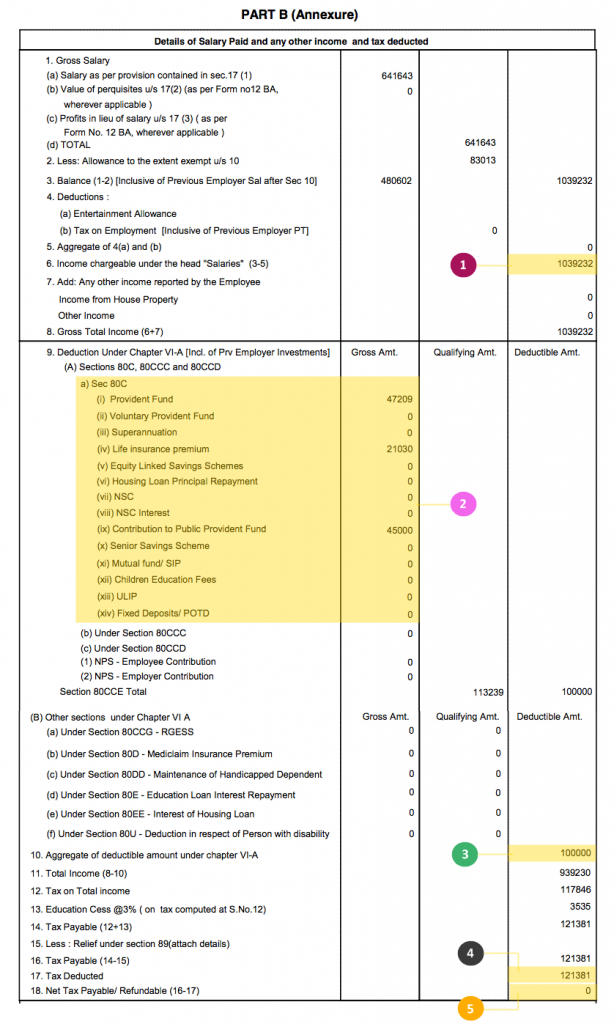
With reference to the image below, here is where you will be able to locate certain information for filing your annual return.
1. Taxable Salary
2. Breakup of Section 80C Deductions
3. Aggregate of Section 80C Deductions(Gross & Deductible Amount)
4. TDS (Tax Deducted at Source)
5. Tax Payable or Refund Due
Form 16
Additional information, which you will require from your Form 16 while filing your annual return are:
a. TDS Deducted by Employer
b. TAN of Employer
c. PAN of Employer
d. Name and Address of Employer
e. Current Assessment Year
f. Your (Taxpayer’s) Name and Address
g. Your PAN

5. Frequently Asked Questions in Form 16

1. How to get Form 16?
a. You can get your Form 16 from your employer. Even if you have left your job, your employer will provide you the Form 16. Unfortunately, this income tax form 16, cannot be downloaded from anywhere.
2. I don’t have Form 16 how do I file my return?
Though this is one of the most important income tax forms, don’t worry if you do not have it. You can still file your income tax return. Click here to learn more.
3. If there is no TDS is the employer required to issue a Form 16?
TDS certificate in Form 16 is issued when TDS has been deducted. In case no TDS has been deducted by the employer, he may not give you a Form 16.
Take a look at our Guide on how to e-file without form 16
4. When the employer deducts TDS and does not issue a certificate?
Any person responsible for paying salaries is required to deduct TDS before making payment. The Income Tax Act lays down that every person who deducts TDS from a payment, must furnish a certificate with details of TDS deducted & deposited. An employer in specific is compulsorily required to furnish a certificate, in the format of Form 16. 
5. If no Form 16 has been issued to me does it mean I don’t have to pay tax or file a return?
While the onus of deducting tax on salaries and providing Form 16 is on the employer, the onus of paying income tax and filing income tax return is on you. If your income from all sources is above the minimum tax slab you are required to pay tax, whether or not your employer deducted TDS. Even when he fails to issue you a Form 16, you must file an income tax return and pay off the taxes that are due.


Tuesday, 29 May 2018

FAQ ON Demand Related Queries

                                                      FAQ ON Demand Related Queries


Demand Related Queries
1. Whom should I approach to rectify the demand amount?
2. How to know my Jurisdictional Assessing Officer details:
3. Where can I view the details of tax paymentand TDS deducted?
4. How can I make payment for the outstanding demand?
5. I have made an error while making the payment through challan, how can it be corrected?
6. Consequences for non-payment of tax demand?
7. How can I request for a copy of the order passed by CPC?
8. What are the common reason for tax demand raised and probable resolution for the same?
9. Queries related to Notice u/s 245
10. Other important points to be considered.


1. Whom should I approach to rectify the demand amount?

The return has been processed at CPC:
File online Rectification to CPC by logging into https://www.incometaxindiaefiling.gov.inwith your user ID and password. Select “Rectification request” under My Account tab and enter the necessary
details.

The return has been processed by Assessing Officer:
Kindly file a rectification application u/s 154 with the Jurisdictional Assessing Officer.

2. How to know my Jurisdictional Assessing Officer details:
    To know your Jurisdictional Assessing Officer details -> Please log on to            https://www.incometaxindiaefiling.gov.in and click on “Know Your Jurisdictional AO”
under “SERVICES” menu.

3. Where can I view the details of tax payment and TDS deducted?
 The tax payment and TDS data available with the Department can be seen in the Form 26AS statement. To check the 26AS statement please login to your e-filing account at https://www.incometaxindiaefiling.gov.in and go to “My Account -> View form 26AS (Tax Credit)”

4. How can I make payment for the outstanding demand?
 Tax payments can be made through a bank authorized to collect Income Tax payments, after filling in the necessary particulars in the Challan provided for this purpose or Online tax payments can be made through the website www.incometaxindia.gov.in under ‘e- Pay Taxes .

Please make the payment quoting minor head “400” only, as wrong minor head may delay the process of settlement of the outstanding demands.

Challan Status: You can ascertain the status of your payment Challan through the website https://tin.tin.nsdl.com/oltas/index.html.These payment will also be reflected in Form 26 AS statement. Please refer question No 3 for further details on Form 26AS.

5. I have made an error while making the payment through challan, how can it be corrected?
 In case you detect any mistake in the Challan after payment of the amounts you may approach the concerned bank branch within 7 days of payment for necessary correction in the challan. If the changes are to be made after 7 days of payment, kindly contact the Assessing officer for the correction.

6. Consequences for non-payment of tax demand?
 Non payment of tax demand attracts penalty and prosecution as per the provisions of the Income tax Act,1961 along with proceedings for recovery listed in Chapter XVII-D of the Income-tax Act, 1961.

 You are also liable to pay simple interest at the rate of one per cent for every month or part of a month for the period of default in accordance with section 220(2) of Income Tax Act, 1961.


7. How can I request for a copy of the order passed by CPC?
 In case you require the intimation order to be resent to you, please log on to https://www.incometaxindiaefiling.gov.in with your User ID and Password. Go to My Account tab  Request for intimation u/s 143(1)/ 154.

 The request can also be placed through CPC call center (Ph.No: 18004252229).

8. What are the common reason for tax demand raised and probable resolution for the same?
Listed below are some of the commonly noticed scenarios, which may result in demand while processing the return at CPC and suggested action/ resolution for such scenarios. If the outstanding demand in your case is on account of any of the reasons below, you are requested to initiate the suggested action at the earliest.


Sr No 1

Scenario
Information in the Income Tax Return (ITR) or appropriate schedules are not filled up correctly and completely resulting in difference in computation of Total income/ Exemption/ Deduction/ Tax/ interest etc by CPC.

Resolution
1. Please refer to the intimation sent to your email address. In case of variation in the figures of total income/ Exemption/ Deduction/ tax/ interest etc, the relevant schedules which caused the error/ difference are annexed to the intimation. On examination of these schedules, the tax payer may apply for rectification online by resubmitting the correct information/ schedules.

2. Tax payer can apply for rectification u/s 154 of the Income Tax Act, through the procedure given below:
a. Please log on to https://www.incometaxindiaefiling.gov.in with your user ID and password.

b. Select “Rectification request” under My Account tab and enter the necessary details.

c. Select appropriate Rectification Type based on information:

(i) If change is required only with respect tax details - > Select “Tax payer is correcting data for tax mismatch only”.

(ii) If change is required with respect to any other data -> Select-“Taxpayer is correcting the data in rectification”.

(iii) If no changes required from assesse -> Select “No further data correction required. Reprocess the case”.

Sr No 2

Scenario
If tax credit as claimed by the assessee has not been allowed while processing.

Resolution
Please refer the tax mismatch communication sent along with the intimation order to your email ID. Tax mismatch communication will contain the details of mismatch and possible resolution.

9. Queries related to Notice u/s 245
 FAQ related to Notice u/s 245 can be viewed by logging onto https://www.incometaxindiaefiling.gov.in and Go to “Help tab” -> FAQs -> ‘Questions related to Notice u/s 245’

10. Other important points to be considered.

 The outstanding demand status can be viewed on the efiling by logging onto https://www.incometaxindiaefiling.gov.in with your user id and password. Go to ‘e-file’ tab->Response to outstanding demand. If after a period of 30 days of your payment the tax demand is not updated at the aforementioned website, please feel free to contact the CPC Customer Care at 18004252229.

 If any of the demands is already paid, but the same continues to be shown as outstanding, please contact CPC Customer Care 18004252229.
                                                     
                                                        <<End of the document>>

Saturday, 31 March 2018

Penalty on Late Filing of Income Tax Return – Section 234F

Penalty on Late Filing of Income Tax Return – Section 234F

New penalty for late filing of Income Tax Return under section 234F is introduced in Budget 2017. Although this penalty is applicable only for income tax return of Financial Year 2017-18 and onwards. If a person who is compulsorily required to file Income Tax Return (ITR) doesn’t file return on time then he is liable to a penalty as follows

AMOUNT OF PENALTY

For person with Total Income of more than Rs. 5,00,000
  1. If ITR is filed on or before 31st December following the last date – Rs. 5,000
  2. If ITR is filed after 31st December – Rs. 10,000
For person with Total Income of less  than Rs. 5,00,000 – Rs. 1,000
Penalty is not applicable if ITR is filed before due date but verification is done after the due date.
In addition to the penalty interest under Section 234A is also levied on late filing of Income Tax Return.
Due Dates for filing ITR
Due date for filing return for person required to gets accounts audited under Section 44AB – 30th September
For all other persons – 31st July
.

PERSONS FOR WHOM IT IS MANDATORY TO FILE INCOME TAX RETURN

The following persons are mandatorily required to file income tax return
  • Company
  • Firm (In Income Tax Act Firm means a Partnership Firm, Sole proprietor firms are considered as an individual)
  • Any other person whose total income exceeds the maximum amount which is not chargeable to income tax.
  • A person is required to file ITR if total income of any other person in respect of which he is assessable under this Act during the previous year exceeded the maximum amount which is not chargeable to income-tax.

Saturday, 3 February 2018

How to calculate Long term capital gain from Equity shares

How to calculate Long term capital gain from Equity shares


From a personal savings and investment perspective, the restoration of long-term capital gains tax on equity income is a huge change. 

Selling stocks or equity mutual funds that you have held for the long term will mean paying taxes on gains accrued since the market closing of January 31. If, in a year, you realise more than Rs 1 lakh of such gains, then 10.04% of that (including cess) has to be paid as tax. 

How to calculate Long term capital gain from Equity shares is explained as under

The purchase price of the stock will be calculated as under

Higher of A and B will be cost of acquisition of shares.

A) Actual purchase price of share 

B) Lower of following 
   i) Highest rate on 31.01.2018 
   ii) Actual sale price 

The above cost of acquisition will be deducted from sale price to calculate capital gain .Flat 10 % tax will be payable on calculated amount of capital Gain.

This concessional rate of 10 per cent. will be applicable to such long term capital gains, if—
  • i) in a case where long term capital asset is in the nature of an equity share in a company , securities transaction tax has been paid on both acquisition and transfer of such capital asset; and
  • ii) in a case where long term capital asset is in the nature of a unit of an equity oriented fund or a unit of a business trust, securities transaction tax has been paid on transfer of such capital asset.
Indexation of the cost of acquisition (determined as per above formula) will not be allowed. Setting off cost of transfer or improvement of the share/unit will also not be allowed. 

So effectively all the gains up to 31.01.2018 has been exempted under new rules . The full details has been explained by example as under.

Tip : As Rs 100000 is exempted from capital gain every year , one can sell so much of their portfolio every years so that he can earn Long term capital gain of One lakh and purchase the same shares again .


STANDARD DEDUCTION TO SALARIED PERSONS

STANDARD DEDUCTION TO SALARIED PERSONS


In order to provide relief to salaried taxpayer, the Union Minister for Finance and Corporate Affairs, Shri Arun Jaitley, proposed to allow a standard deduction of Rs. 40,000/- in lieu of the present exemption in respect of transport allowance and reimbursement of miscellaneous medical expenses. However, the transport allowance at enhanced rate shall continue to be available to differently-abled persons. Also, other medical reimbursement benefits in case of hospitalisation etc., for all employees shall continue.

Presenting the General Budget 2018-19 in the Parliament here today, the Finance Minister said, “Standard deduction shall significantly benefit the pensioners also, who normally do not enjoy any allowance on account of transport and medical expenses. The revenue cost of this decision is approximately Rs.8,000 crores. The total number of salaried employees and pensioners who will benefit from this decision is around 2.5 crores.”

BUDGET 2018STANDARD DEDUCTION
STANDARD DEDUCTION RS 40000/-
TO SALARIES /RITERED PERSON
BUT EXEMPTION OF TRANSPORT 
ALLOWANCE =19200/-  WITHDRAWN
MEDICAL REIMBURSEMENT =15000/- WITHDRAWN
NET BENEFIT =40000-34200=RS 5800

Shri Jaitley said, “The Government had made many positive changes in the personal income-tax rate applicable to individuals in the last three years. Therefore, I do not propose to make any further change in the structure of the income tax rates for individuals. There is a general perception in the society that individual business persons have better income as compared to salaried class.”

The Finance Minister further said, “Apart from reducing paper work and compliance, this will help middle class employees even more in terms of reduction in their tax liability.”

Transportation allowance is presently exempted @ 1600 per month and medical reimbursement is exempted up to 15000 per year so total 1600*12=19200 +15000=34200 is exempted and instead of these two deductions /exemption standard deduction of Rs 40000 has been allowed. so net benefit of just 40000-34200=Rs 5800/-

This deduction is more beneficial to retired persons and persons who are not getting the benefits of medical reimbursement and transport allowance as they will get flat Rs 40000/- deduction.


Search This Blog